Friday, April 17, 2009

Charlie Chaplin


During class for the past week, students have been giving power points on chapter 28. Seth S. gave his presentation on many different topics, but one was about Charlie Chaplin. Even if you've never heard of Chaplin, it is most likely that you have seen his picture before and just had no clue as to who he was. He was in many silent movies, the old fashioned kind where when someone spoke, there was text across the screen indicating what they were saying. Usually if there was any sound at all in the film, it was just the music they played along with the movie. Mr. Chaplin won two Oscar awards for his films and was the first actor to be on Times Magazine. A famous star still remembered today.

Some facts I found interesting about Charles Chaplin:

- The Queen of England actually made Chaplin into a Knight

- He had eight children and four wives

- Chaplin was the first person to do the "Table Ballet" or "Bread Roll Dance" http://www.youtube.com/watch?v=xoKbDNY0Zwg

- His death was on Christmas Day

- After he was buried, he was kidnapped by Switz who dug up his body for money from his family. They never saw the money though because the police officers caught the people who did it.

Thursday, April 9, 2009

Waterfall House


Fallingwater Home was designed Lloyd Wright in 1937. Wright built this home as a vacation home for a family who lived in Pittsburgh, PA, the Kaufman family. The Kaufman family owned a department store, now known as Macy's. They hired Mr. Wright to design this house because of the son in the family, he was very interested in Wright's work. The reason this house is magnificent is because of where it is built. The house hangs 30' over the waterfall and its structure is unbelievable. Today, over 70,000 visitors come to see this amazing house each year. This house is in Bears Run, PA and is one of Wright's master pieces of all time. I really like this house because I think it would be a cool house to live in. Wake up in the mornings and walk out onto the balcony which is hanging over a waterfall and the house is surrounded by nature! That would be pretty nice. And to top everything, I am still puzzled on how he came up with the idea of building a house over a waterfall and the construction was completed. It truly is a masterpiece of Wright's and one that inspired many European workers.

Tuesday, April 7, 2009

Connection Across Time

April 6, 2009
Many remeber World War I involving many countries and many deaths. Some people do not remember that what started the war was the assassination of Franz Ferdinand, his wife and their unborn baby. Just leaving the City Hall in an open top car, Gavrilo Princip shot two bullets at the couple because he felt it would help free his people from Austro-Hungarian Empire. Others were also involved in planning the assassination and were sentenced to prison and some to death. And so begun World War I.
On September 11, 2001, America was attacked by terrorists, leaving many wounded and dead. American people feared for their lives because it started out as a normal day, then planes bgan crashing into important buildings such as the Twin Towers. Family and friends were lost that day, whether from the planes or trying to rescue someone in hope that there were survivors. Ever since that day almost eight years ago, America has had soldiers stationed in Iraq, Iran and Afghanistan, trying to find those responsible for the attacks so something like 9/11 would never happen again.
The start of WWI and America stopping terrorists were very similar, both started with deaths and attacks. Another similarity is the deaths that are being taken while fighting this battle so no harm comes to their country ever again. New technology and weapons were developed during both wars and also improving the old weapons. In the end of WWI, America, France, Italy and Great Britain all decided what was going to happen to the countries that were involved in the war, restoring some countries while punishing others. In Iraq, America is sort of doing the same by trying to develop a better government for the people in Iraq. Although some may argue that history does not repeat itself, many similarities occur over and over again through out history. The whole world can learn from these wars and others what tactics worked and which ones failed and should never be tried again.


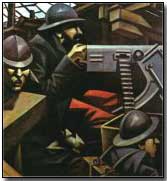
Christopher Nevinson painting.

April 6, 2009
This painting was done by Christopher Nevinson, I am unsure of what the title is but is on page 886 of our text books. It shows three soldiers during World War I with a machine gun aimed at the enemy waiting to fire. Right above the soldiers' heads is a barbed wire and there is what looks like wood surrounding them. I am assuming these are not German soldiers because German soldiers have the Nazi flag symbol wrapped around their arm and these soldiers do not have that on. Two of the soldiers are spotting the enemies while the third soldier is not looking. It makes me wonder what he is looking at or thinking about that has him distracted from the enemy or is he waiting for the bullets to go off and cannot look at the gun because it might damage his eyes. This painting does show how much of a small amount soldiers had during battles and not much room to move, so if a bomb came and hit them, they would most likely not have enough time to get out of the way. Also, since they are in such a small amount of space, does that make them an easier target for the enemy? Many questions can be asked on how to keep a soldier safer during battle, especially after having an actual image such as the one Nevinson caught in his painting.


Assassination of Franz Ferdinand

April 6, 2009
On March 26, the class received an article on the assassination of Franz Ferdinand. It gave some information of Ferdinand and how his wife was treated during their marriage. For example, Sophie Von Chotkovato (his wife) was not allowed to join her husband when he sat in the royal box or carriage.

Many people did not like Ferdinand because they didn't want him in Austro-Hungarian Empire and the fact that Ferdinand would become their Emperor. The only way, some people saw, out was to assassinate Franz Ferdinand at his next visit. The group who planned the assassination were called 'Black Hand' and their opportunity came in June 1914, when Ferdinand visited Bosnia. In the morning of June, Gavrilo Princip, who was only 19 years old, fired two shots at Ferdinand and his wife Sophie but killed three people. Sophie was pregnent the day she died and died instantly after being hit with the bullet. Following her death was her husband's, saying his last words 'Sofia' at his wife right before he too died. Princip was sentenced to twenty years and since he was under 21, he missed the death sentence but died in prision due to tuberculosis on April 28, 1918.

Leaders are assassinated many times through out history because of what they believe in or their posistion in government. Gavrilo Princip was only a year older than I am when he assassinated a family because he felt that he was saving his people from Ferdinand's future for their country. Would the future have been different if this family was not assassinated? I think it would, but whether or not it would be for the better of the people Princip was trying to protect is hard to say. It would be like writing what happened if the Romanov family was not murdered and how Russia changed. No one knows for sure what would have happened to Russia then, we can only assume. Knowing that Princip was only a year older than I am now, it makes me wonder if any of my friends who are 19 could assassinate an entire family if they truly believed in something. Not that many people could, but there are always those few who could if they felt it needed to be done.


Thursday, April 2, 2009

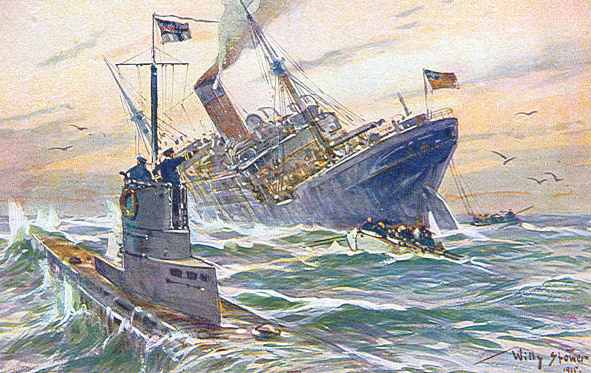
Painting by Willy Stower

April 2, 2009
Painting by~

Willy Stower, 1917

During World War I, Germany began to use U-boats or submarines. Most Navy ships were never expecting a ship underneath neath them, especially one that would attack them. Different Navy ships would be attacked while out to sea by the German U-boats, making other countries even more angrier. This painting Stower captured the image of a ship in distress after being hit by the enemy, and the enemy rising to the surface to watch the ship drown. The flag on the ship was an American flag which could have been the time that made them join World War I, after Germany attacked unexpectedly. I really like this painting because of all the colors the painter used for each detail. Also, he has one of the Germans holding up their arm, 'Hail Hitler' sign, after attacking a ship for Germany.

America Not Standing Behind Its Own Leader?

Wednesday, April 1, Maz's class discussed the Versailles Treaty. Mainly who was involved, what they wanted, why they wanted it, and the result of the treaty. Georges Clemenceau, for example, wanted to punish Germany and for them to pay for any damages that occurred during WWI. His main goal was total revenge and some could see it as harsh as Lloyd George did. He too wanted revenge on Germany, but in more of a peaceful way (basically Germany would pay for the damages done and they would be punished for causing the war). United States of America's President Wilson wanted many things out of this treaty, but one he wanted most was the League of Nations. The League of Nations had one basic goal, to prevent a war like this to ever occur again.
Wilson saw the League of Nations as a way to prevent another war like WWI was, but unfortunately not every country agreed with his ideas. There were three countries that did not agree to sign the League of Nations. Germany, naturally, did not want it because they saw it as an insult to their country since everyone was blaming them for starting WWI. Another country was Russia. The final country was one someone might scratch their heads over for not understanding, it was the United States of America. President Wilson created the idea of League of Nations and yet, he cannot get his own country to follow his lead? Other leaders in America did not like Wilson and tried to go against any ideas of his that they could, and so they did when it came to signing the League of Nations.
This came as a shock to me because usually America follows its Commander's lead unless it is harmful for America itself. The League of Nations did not seem like a bad idea if it could really prevent war and less lives loss, but I am sure it had its downsides which could have been the reason why America did not sign it. Was there an actual reason behind not signing it? Or did Senators of the time just really not like President Wilson and decide to go against him as we think they did?